
A floor that was flat last month and is suddenly lifting at the edges or tenting in the middle is trying to tell you something. With SPC, lifting almost never means a faulty plank. It usually points to how the floor was installed or what's happening in the room around it. Here's how to read the symptoms and put it right.
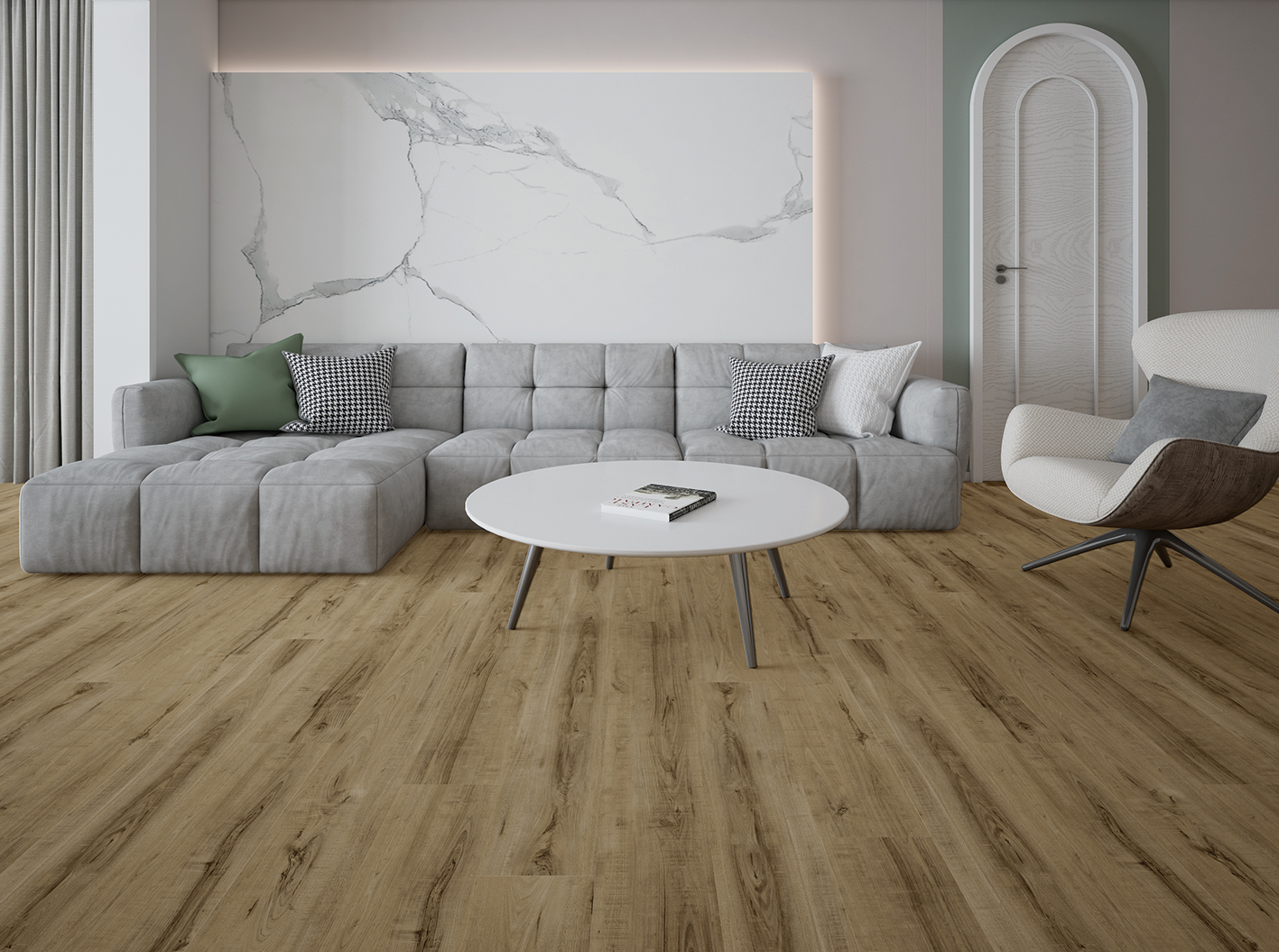
Peaking, gapping, or curling: name the symptom
Lifting shows up in a few ways, and each points somewhere different. Peaking is when two planks push against each other and tent along the seam. Gapping is the opposite, where planks pull apart and leave a line. Edges curling up at a wall or doorway is usually an expansion problem. Matching the symptom to the cause is the fastest route to a fix.
The usual causes
- No expansion gap: SPC expands and contracts with temperature. If it's butted tight to the walls with nowhere to move, it lifts.
- Blocked expansion gap: skirting, door frames, or a heavy cabinet pinning the floor stops it moving and forces it up.
- Uneven subfloor: dips or bumps over the manufacturer's tolerance let planks flex and unclick.
- Big temperature swings: a floor laid cold then heated hard, or one baked by direct sun, moves more than the gaps allow.
- Trapped moisture below: the core is waterproof, but water under the planks can still lift them off an uneven base.
- Rushed acclimation: planks laid straight from a cold van never settle to room temperature first.
How to fix a floor that's already lifting
Start with the edges. Pull the skirting or trim and check there's a consistent expansion gap around the whole perimeter, including at doorways and pipes. If the gap is missing or blocked, trimming the plank edges back and freeing anything pinning the floor often lets a peaked seam settle flat again on its own. For a plank that's unclicked, the reversible Unilin click system on MILAT floors means you can lift the row, reseat the joint, and lock it back down rather than replacing anything.
If the subfloor is the problem, there's no shortcut: the floor needs lifting in that area, the base levelling to the flat tolerance in the fitting guide, and the planks relaying. It's the fix people skip and the one that lasts.
| What you see | Most likely cause |
|---|---|
| Seams tenting up | No or blocked expansion gap |
| Gaps opening between planks | Cold room or poor acclimation |
| Edges curling near a wall | Trapped moisture or tight perimeter |
| Springy, clicking planks | Uneven subfloor |
Prevention starts the day the boxes arrive
Most lifting floors were doomed before the first plank clicked. Boxes carried straight from a cold van into a warm room and installed within the hour are laid at the wrong temperature, and the floor's first summer will find them out. Let the packs acclimatise flat, in the room, per the instructions. Use the waiting time to check subfloor flatness with a straightedge, because a rigid floor rocking over a hump concentrates stress on joints. An hour of patience and a two-metre level prevent the majority of callbacks we ever hear about.
The kitchen island problem
A floating floor must float. When a heavy kitchen island, a loaded bookcase wall, or fitted cabinetry is placed on top of the planks, that zone is pinned to the subfloor while the rest of the field tries to move with temperature. The floor then buckles at the nearest weak line, often a metre or two away from the actual culprit, which is why the cause gets missed. Best practice is to install islands and fixed cabinetry first and run the floating floor up to them with an expansion gap, not underneath them.
Sun traps, glass doors, and local heat
A floor can be fine for years and lift only in the rectangle in front of a sliding glass door. Direct sun through glazing heats that patch far beyond room temperature, and the localised expansion pushes against cooler surrounding boards. SPC's mineral core resists this better than most floating floors, but physics still applies at the extremes. If a floor lifts only in a sun trap, the fixes are shade management with blinds or exterior shading and, on new installs near large glazing, generous expansion detailing on that side of the room.
Doorways and transitions: small parts, big consequences
Long uninterrupted runs of floating floor through doorways look elegant and behave badly. Each room expands toward the doorway, the narrow threshold becomes the pressure point, and peaking appears exactly where the two fields meet. Transition profiles at doorways exist to break large floors into independent zones, and the manufacturer's instructions state the maximum run length before a break is required. If your lifting is centred on a doorway with no profile, you have very likely found your answer, and the repair is mercifully cheap.
When to call the installer, and when the manufacturer
Triage saves everyone time. Symptoms that map to site conditions, meaning peaking at doorways, buckling near heavy furniture, lifting after a flood, point to the installation or the environment, so start with your installer. Symptoms present from day one, such as joints that never sat flush or planks with visible profile defects, point to product and belong with the retailer and manufacturer, backed by batch numbers and photos. Describing the symptom precisely, where, when it appeared, what changed in the room, gets you a correct diagnosis in one conversation instead of five.
Talk to MILAT Floor
Samples, specifications, OEM & private label, wholesale or export — our team is ready.