
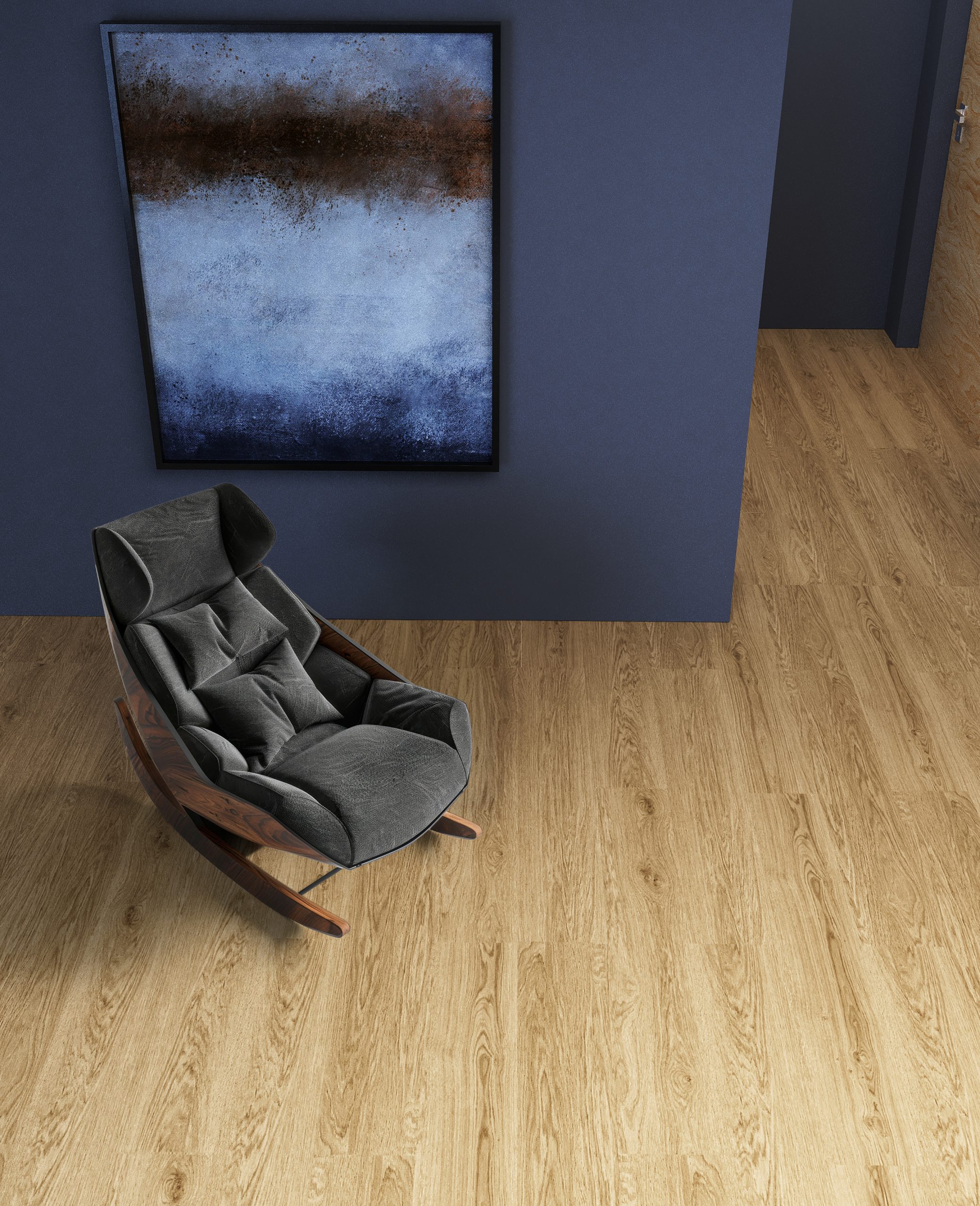
SPC stands for Stone Plastic Composite — a rigid-core, 100% waterproof vinyl flooring engineered for everyday life. At MILAT Floor, every plank pairs an SPC core with an Embossed In Register (EIR) surface, so the floor looks like natural wood or stone and holds up to real-world use.
What does SPC stand for?
SPC means Stone Plastic Composite. The name comes from the rigid core at the heart of the plank — a dense composite that gives the floor its stability and rigidity. Because the core is rigid rather than flexible, SPC resists movement, hides minor subfloor imperfections, and stays dimensionally stable.
The 6-layer construction
MILAT SPC planks are built from six precision layers, working together from a UV-protected surface down to the locking core:
- 2X UV Coating — a protective varnish that filters UV light and keeps the design from fading.
- Wear Layer — shields the printed design from abrasion and everyday foot traffic.
- Decorative Layer — advanced digital printing carries the plank's realistic wood or stone finish.
- Core — a high-density layer delivering dimensional stability and rigidity.
- Acoustic Layer — an IXPE dampening layer improving acoustic absorption by up to 21 dB.
- Unilin Click Locking — a licensed Unilin locking system for fast, tool-free installation.
Is SPC flooring waterproof?
Yes. MILAT SPC floors are built on a 100% waterproof core, which means water will not damage or swell the plank. That makes SPC a strong choice for kitchens, bathrooms, laundry rooms and other moisture-prone spaces where wood or laminate would struggle.
How durable is SPC flooring?
Durability comes from the combination of a hard wear layer and a UV coating over a rigid core. MILAT rates its floors at AC5 — the highest common wear class — suitable for heavy residential use and demanding commercial spaces.
Where can you use it?
SPC suits almost any interior: living spaces, kitchens and bathrooms thanks to the waterproof core, and busy commercial areas. MILAT's Triollo EIR collection is designed specifically for heavy commercial traffic.
How is SPC flooring installed?
MILAT planks use a licensed Unilin click locking system — no glue and no nails. Installation is tool-free, reversible, and up to 60% faster than traditional glue-down methods.
Where SPC came from
SPC is a young product with old parents. Vinyl flooring has been around for generations, and rigid click floors came out of the laminate world. In the 2010s the two ideas merged: manufacturers began pressing vinyl's waterproof chemistry into a stiff, stone-filled core that could carry a click joint. The result solved laminate's biggest weakness, which was water, and flexible vinyl's biggest weakness, which was telegraphing every bump in the subfloor. That is why SPC took over renovation projects so quickly. It was not a marketing invention; it was a genuine engineering fix.
Can SPC go over an existing floor?
Often, yes, and this is one of its quietest advantages. Because SPC floats and the rigid core bridges small imperfections, it can be laid directly over existing ceramic tile, old vinyl, or a sound concrete screed without ripping anything out. Renovators save days of demolition, dust, and skip hire. The conditions are simple: the old surface must be flat within the installer's tolerance, dry, and solidly bonded. Deep grout lines may need skimming, and soft floors like carpet must always come up first. Never stack a floating floor on another floating floor.
How SPC behaves through the seasons
Every floor moves with temperature. SPC moves far less than wood or laminate because limestone is dimensionally lazy: it does not care much about humidity at all, and its thermal movement is modest and predictable. That stability is why SPC handles conservatory-adjacent rooms, south-facing glazing, and homes that sit empty and unheated for weeks. The floor still needs its perimeter expansion gap, but you will not see the seasonal gapping and cupping that wood owners learn to live with. For holiday homes and rentals that cycle between hot and cold, this is often the deciding factor.
What a manufacturer checks before a plank ships
From the factory side, a good SPC plank is a chain of small verifications. At MILAT Floor we check the core recipe as it is blended, the fusion of the decor film and wear layer, the cure of the 2X UV coating, and the milling of the licensed Unilin click profile, because a click joint cut a fraction of a millimetre off will frustrate an installer three thousand kilometres away. Certification frames all of it: FloorScore for indoor air quality, CE Declarations of Performance for the EU, and ISO management systems covering quality and environment. When you buy SPC, you are really buying the discipline behind these checks.
Mistakes first-time SPC buyers make
- Choosing on thickness alone instead of wear layer, core quality, and click system
- Skipping physical samples and ordering from a screen photo
- Ignoring the acoustic layer, then paying separately for underlay the floor already had built in
- Assuming waterproof flooring makes the room waterproof and skipping perimeter sealing in wet areas
- Buying exactly the square meterage of the room with no cutting allowance or spare planks
None of these mistakes shows up on day one. They show up in year two, as noise, wear, or a repair with no spare planks to do it with. Ten minutes of homework prevents all five.
Talk to MILAT Floor
Samples, specifications, OEM & private label, wholesale or export — our team is ready.