
EIR stands for Embossed In Register. It is a surface-texturing technique where the physical embossing is aligned precisely — 'in register' — with the printed wood or stone design, so the grain you see matches the texture you feel. Every MILAT Floor collection uses an EIR surface.
What does 'in register' mean?
On a floor, 'in register' means the embossed texture lines up exactly with the printed image beneath it. Where the design shows a grain line, a knot or a stone vein, the surface is embossed to match — so light, shadow and touch all follow the same pattern.
Why EIR looks and feels real
Because the texture and the print share the same map, EIR surfaces catch light like real timber or stone and feel authentic underfoot. It is the difference between a flat printed look and a floor that reads as genuine at close range.
EIR across MILAT collections
All three MILAT collections are built around an Embossed In Register surface:
- Exclusive EIR — the flagship range, spanning wood-grain, stone and aged looks.
- Perfecta EIR — a versatile range for a wide variety of projects.
- Triollo EIR — engineered for heavy commercial traffic.
EIR plus a waterproof SPC core
MILAT pairs the realism of EIR with the performance of a rigid SPC core: 100% waterproof, AC5 wear, and a licensed Unilin click system — so the floor looks authentic and performs in real-world conditions.
How EIR is made on the production line
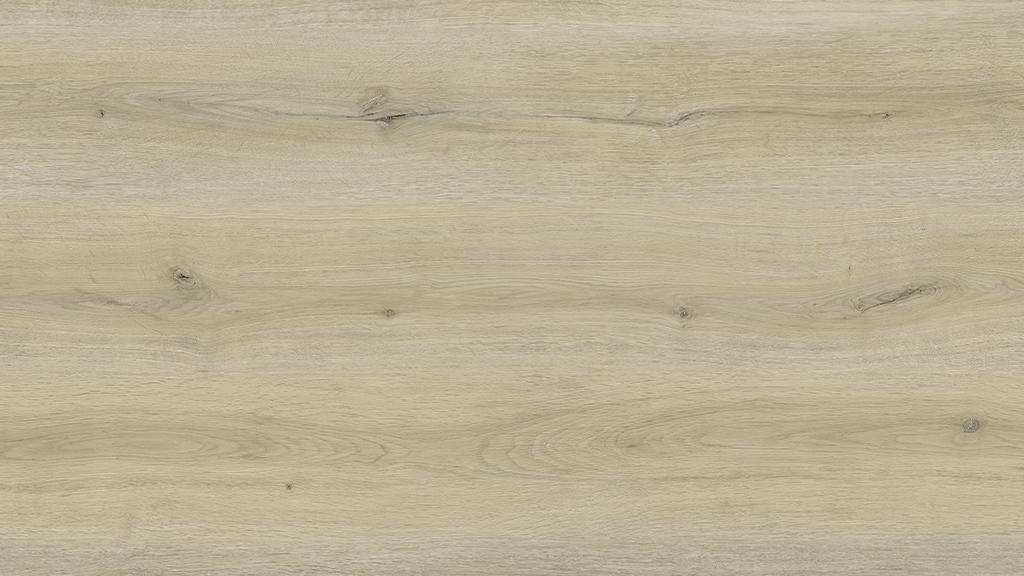
EIR starts long before the press. The decor film and the embossing plate are developed as a matched pair: the designer maps every knot, cathedral grain and mineral streak in the print, and the plate is engraved to mirror that map. On the line, the plank passes through a press where registration systems keep film and plate aligned within a very tight tolerance. If the alignment drifts even slightly, the texture lands beside the printed grain instead of on it, and the trained eye catches it immediately. That is why true EIR demands better process control than standard embossing, and why not every factory offers it.
How to tell real EIR from generic embossing in a showroom
Run your fingertip along a printed knot. On genuine EIR the surface dips and rises exactly where the print says it should; on generic embossing you feel a repeating tick-tick texture that ignores the design underneath. Tilt the plank against the light next. EIR scatters reflections unevenly, the way sawn timber does, while a uniform emboss throws back a regular sheen pattern. Finally, compare two planks of the same decor: an EIR range pairs each print variant with its own texture, so no two adjacent boards feel identical.
- Touch test: texture must follow the printed grain, not cross it
- Light test: reflections should break up irregularly, like real wood
- Repeat test: different print variants should carry different textures
Does EIR change how a floor lives day to day?
A common worry is that a deeper texture traps dirt. In practice EIR relief is shallow and sealed under the wear layer and UV coating, so a damp mop lifts dust out of the grain without scrubbing. The texture actually works in your favour in two ways: fine scratches and dulling from foot traffic hide inside the irregular surface far better than on a smooth gloss plank, and the broken-up reflection keeps smears and footprints from showing between cleans. Matte, textured floors simply forgive daily life more than polished ones.
EIR and slip resistance
A textured surface gives shoes and bare feet more to grip than a flat film, which matters in entrances, kitchens and anywhere water gets tracked in. EIR is not a substitute for a rated safety floor in a commercial wet room, but in a home or office it adds a margin of grip that smooth vinyl lacks. Combined with a waterproof SPC core that will not swell when splashed, it makes textured SPC a sensible pick for the rooms where hard floors usually get slippery.
Why manufacturers treat EIR as a signature, not a feature
From the factory side, EIR is where design and engineering meet. A press plate is a serious investment per decor, so a manufacturer who builds an entire programme on EIR is committing to fewer, better designs rather than a long list of flat prints. MILAT took that route: all three collections, Exclusive, Perfecta and Triollo, carry EIR surfaces across all 54 designs. For a buyer, that consistency means you can specify any decor in the range and know the realism standard does not drop on the cheaper lines.
Talk to MILAT Floor
Samples, specifications, OEM & private label, wholesale or export — our team is ready.