
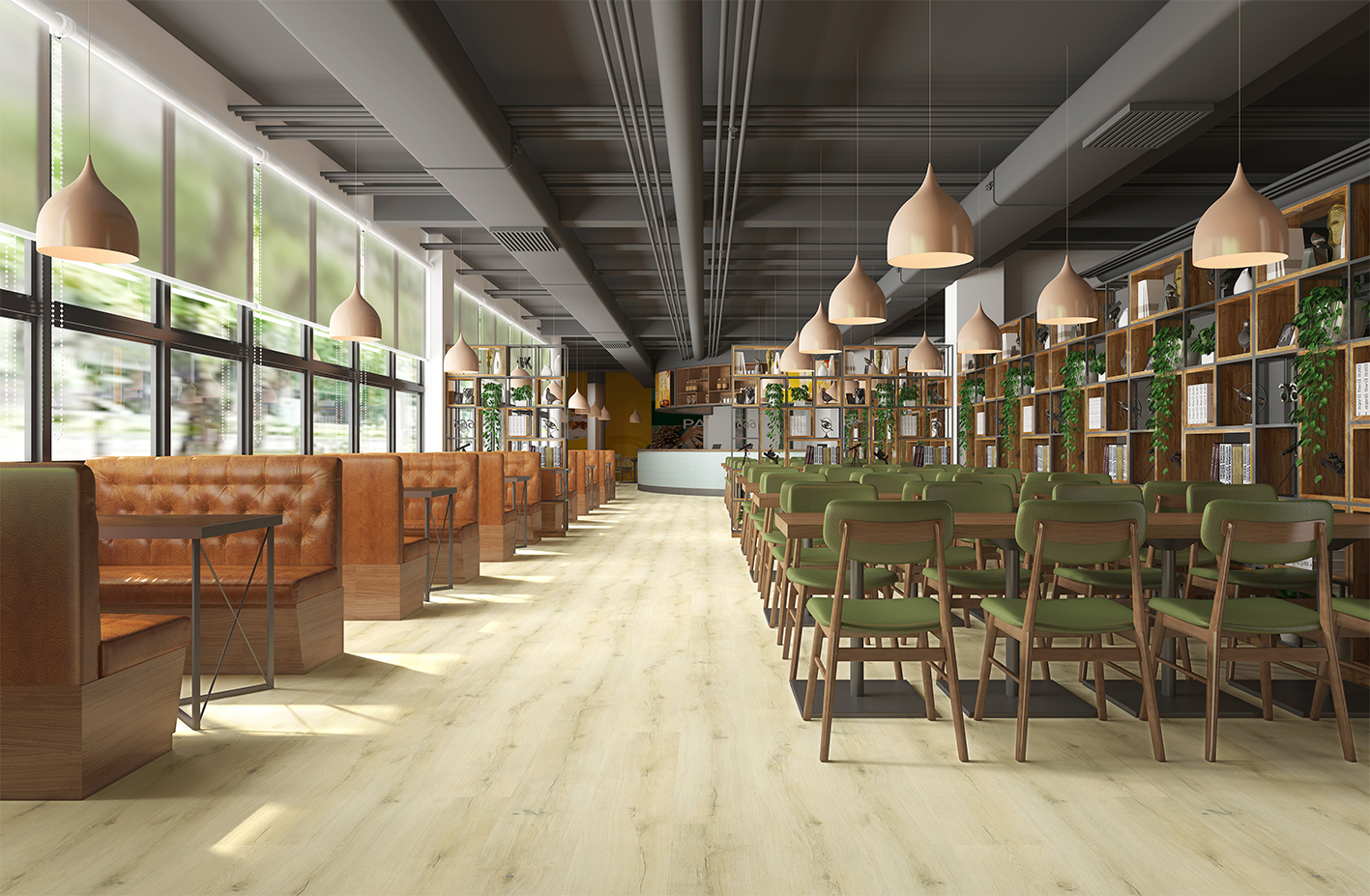
Click flooring is any floor whose planks lock to each other along their edges instead of being glued or nailed down. The planks join with a machined tongue-and-groove profile that clicks shut, and the whole floor rests on top of the subfloor rather than being fixed to it. It is the reason a room can be floored in an afternoon by someone who has never laid a plank before.
How click-lock works
Every plank has a tongue on two edges and a groove on the other two. The tongue of one plank slots into the groove of its neighbour and locks in place. Because the connection is mechanical, the joint holds the planks tight to each other and keeps the surface level, no adhesive required.
Tongue-and-groove vs angle and drop-lock
The term tongue-and-groove describes the shape of the edge. How you engage that edge is the mechanism, and there are a couple of common ones:
- Angle (fold-down): hold the plank at a slight tilt against the last row, then lower it flat so the long edge locks.
- Drop-lock: engage the long edge first, then push the short end straight down until it clicks, useful in tight spots.
- Both leave a joint that resists pulling apart sideways and lifting upward.
No glue, and the floor floats
Because the planks only connect to each other, the finished floor is not bonded to the subfloor. It floats as one large sheet, free to expand and contract slightly with temperature and humidity. That is why click floors are left with a small gap around the edges of the room, hidden later by skirting or trim.
Click floors cover several materials. Laminate popularised the system, and rigid vinyl such as SPC and LVT now uses it widely. MILAT's SPC planks, for example, use a licensed Unilin click that goes down tool-free and can be lifted again if a board needs replacing.
What makes it beginner-friendly
- No wet adhesive, so nothing to clean up or wait on.
- Mistakes are recoverable: unlock a plank and reseat it.
- Most cuts are straight, and the joint does the alignment for you.
- You can usually walk on it right away.
Licensed profiles versus copies
Not all clicks are born equal. The best-known locking systems, Unilin's among them, are patented, licensed technologies: a factory pays for the licence, mills the profile to the licensor's tolerances and is audited on it. Unlicensed copies imitate the shape without the tolerance discipline, and the difference appears exactly where you cannot see it, in joint strength and how the profile survives repeated engagement. It also carries legal risk for importers in markets where the patents are enforced. MILAT mills a licensed Unilin click for both reasons, and shows the licence to any buyer who asks.
Click is a system, not just a shape
The same locking principle behaves differently depending on what it is machined into. In laminate, the click is cut into a wood-fibre core that hates water; in SPC it is milled into a dense mineral core that ignores it; in WPC the core is lighter and softer, so the joint relies more on profile geometry. This is why a click floor's performance is always the marriage of profile and core. A superb profile in a weak core still gives a weak joint, and judging a floor means judging both together.
This is also why sample testing beats brochure reading. Click two sample planks together and take them apart a few times: a good system engages with a definite, confident action and separates cleanly, without fuzzing or whitening along the milled edge. Your hands can feel tolerance quality that no datasheet communicates.
Mistakes that break a click joint
When a click floor fails, the joint usually took the blame for an installation error. The repeat offenders are worth knowing before the first row goes down.
- Forcing planks flat instead of engaging them at the designed angle
- Tapping directly on the fragile profile edge instead of using a tapping block
- Skipping subfloor flattening, so joints flex over hollows until they fatigue
- Leaving no expansion gap, so seasonal movement loads the joints instead of the perimeter
- Reusing planks whose profiles were damaged during a previous careless disassembly
Very large areas and expansion joints
A floating floor is one connected raft, and rafts have a size limit. Over very long continuous runs, accumulated expansion and contraction can exceed what perimeter gaps absorb, so manufacturers specify a maximum run length beyond which a transition profile should divide the field. Doorways between rooms are natural places for these breaks. Ignoring the limit is how floors end up peaking in summer or gapping in winter in large open-plan spaces. Check the installation guide for the stated limits before planning a huge unbroken area, and treat the limit as a design input, not an obstacle: a well-placed transition at a doorway is invisible in daily life.
How long a click joint lasts
A quality click joint in a rigid core is not the wear item people assume; the floor's surface will usually tire before the mechanism does. What ages a joint is movement it was never meant to absorb: an uneven subfloor flexing it daily, missing expansion gaps loading it seasonally, or repeated careless disassembly. Installed on a flat base with proper perimeter gaps, a licensed profile in an SPC core stays tight for the life of the surface, and survives the occasional deliberate take-up-and-relay besides. Buy the joint once, install it properly, and forget it exists; that is the whole promise of the technology.
Talk to MILAT Floor
Samples, specifications, OEM & private label, wholesale or export — our team is ready.