
Walk into a flooring showroom and the vinyl section alone throws a dozen acronyms at you — LVT, LVP, SPC, WPC, EVP, plus plain old sheet vinyl. They are not competing brands. They are branches of one family tree, and once you see how they connect, the choice gets a lot simpler.
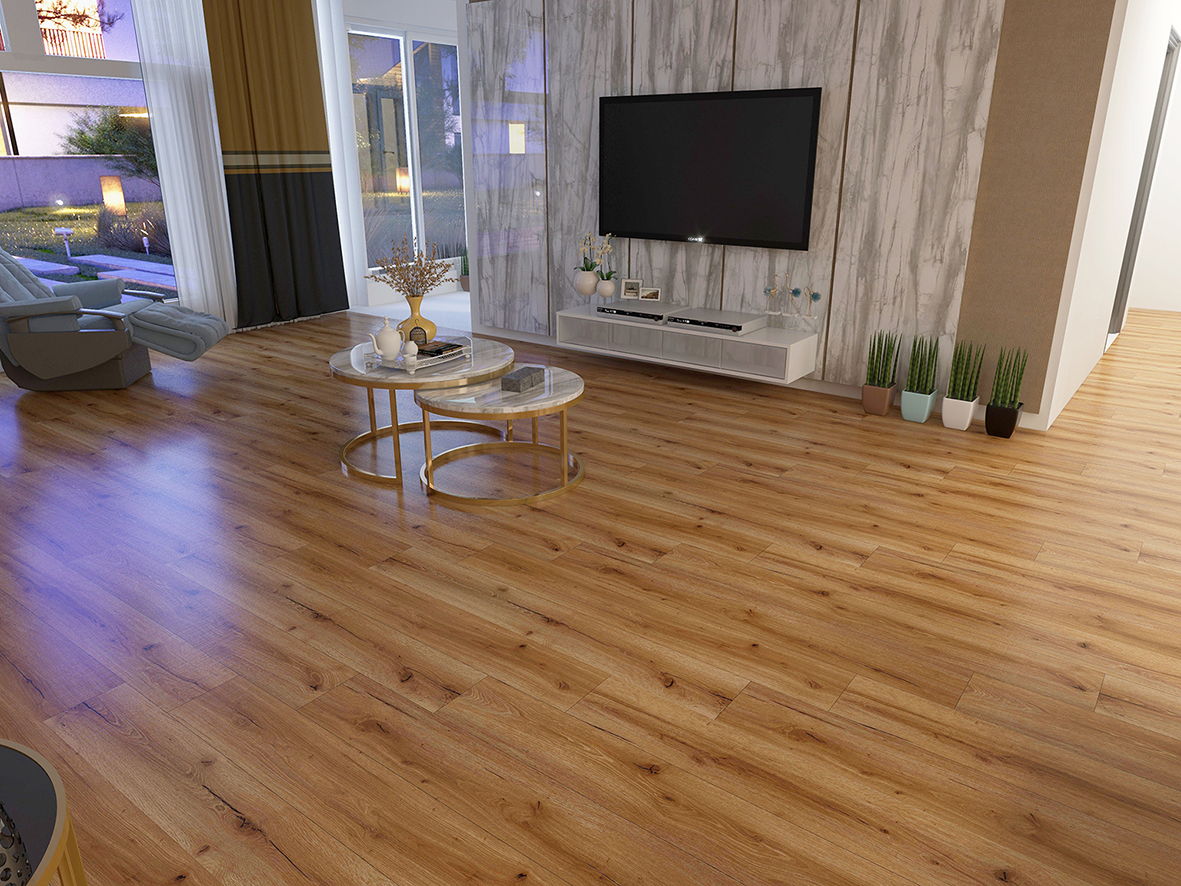
The vinyl family in one picture
Every product here is made mostly from PVC (polyvinyl chloride), which is what makes it water-resistant and easy to clean. What separates the types is format and core. Sheet vinyl comes in wide rolls. Everything else comes in planks or tiles, and among those the dividing line is whether the core is flexible or rigid.
- Sheet vinyl: large rolls, few seams, budget-friendly
- LVT / LVP: individual flexible planks and tiles with realistic prints
- Rigid core (SPC and WPC): planks with a hard, floating, click-together core
- EVP: a marketing name that almost always means rigid core
Sheet vinyl
The original resilient floor. Sheet vinyl rolls out in widths of a few metres, so a whole bathroom can be covered with barely a seam — handy where water might otherwise creep between joints. It is the cheapest option and the softest underfoot, but the printed look is less convincing than modern planks, and a bad tear is hard to patch invisibly.
LVT and LVP
Luxury vinyl tile and luxury vinyl plank raised the game with layered construction and photographic prints. LVT tends to mean stone- and tile-look squares; LVP means wood-look planks. Both look far more realistic than sheet, come in glue-down or click versions, and let you replace a single damaged piece instead of the whole floor. Traditional LVT is flexible, which keeps it thin and quiet but demands a smooth subfloor.
Rigid core: SPC and WPC
Rigid core took the LVT surface and bonded it to a solid board so it clicks together and floats. SPC (stone plastic composite) has a dense limestone-based core — hard, thin, very stable in heat, and highly dent-resistant. WPC (wood plastic composite) uses a foamed core that feels softer, warmer, and quieter, trading a little stability for comfort. Both are fully waterproof through the plank, which is why rigid core has taken over kitchens and bathrooms.
| Type | Core | Waterproof | Best for |
|---|---|---|---|
| Sheet vinyl | Flexible, rolled | Water-resistant | Budget bathrooms, rentals |
| Flexible LVT/LVP | Flexible plank | Surface-resistant | Smooth subfloors, quiet rooms |
| WPC | Foamed wood-plastic | Waterproof | Comfort-first living spaces |
| SPC | Stone-plastic | Waterproof | Wet areas, sun rooms, commercial |
So which type should you pick?
Match the floor to the room, not the other way round. A rental bathroom on a tight budget still suits sheet vinyl. A flawless subfloor and a love of soft, silent floors leans toward flexible LVT. Most renovations — uneven subfloors, kitchens, high traffic, DIY installs — land on rigid core, with SPC for durability and heat stability and WPC for underfoot comfort. MILAT builds both SPC and LVT, so the same design can be specified in the construction a project actually needs.
How to identify the type from the box in your hand
Labels rarely announce their category honestly, but the physical product does. Flex a plank: if it bends easily, it is traditional LVT or LVP; if it stays stiff, it is a rigid core. Look at the edge: a rigid plank shows a dense, stone-flecked core for SPC or a lighter foamed core for WPC. Check the back for an attached foam or cork layer, which is common on rigid cores and rare on glue-down LVT. Finally, the installation instructions give it away: glue-down means flexible, click-together means rigid or a click LVT. Thirty seconds with an open box beats an hour of brochure reading.
Marketing names versus engineering names
The industry has buried a simple family tree under invented labels: waterproof core, hybrid flooring, stone-look luxury plank, next-generation vinyl. Australia calls rigid core hybrid; North America leans on EVP; some brands invent their own trademarks entirely. None of these change the underlying engineering, which always comes down to three questions: is the core flexible or rigid, is a rigid core stone-based or wood-composite-based, and how thick is the wear layer. Ask those three questions of any product, whatever it calls itself, and you can place it on the family tree in seconds.
Where each type goes wrong
Every branch of the vinyl family has a misapplication that generates most of its complaints.
- Sheet vinyl in heavy commercial traffic without the right grade: wears through and gouges
- Glue-down LVT on a damp or dusty subfloor: adhesive failure and lifting edges
- Cheap floating LVT in sunny rooms: expansion, ripples and gaps
- WPC under heavy rolling loads: indentation from the softer core
- SPC over a badly uneven subfloor: a rigid plank telegraphs and rocks over high spots
Notice that almost none of these are product failures in the strict sense. They are matching failures, which is why understanding the types matters more than memorising brands.
Residential and commercial grades cut across every type
Type tells you the construction; grade tells you the duty. Every branch of the family is made in lighter and heavier versions, distinguished mostly by wear layer thickness and rated wear class. A commercial-grade sheet vinyl can outlast a residential-grade SPC in a shop doorway, and a heavy SPC such as an AC5-rated plank is built for traffic a light residential LVT should never see. When comparing across types, always compare at the same intended duty. MILAT's SPC range runs up to AC5 precisely because export buyers spec the same product family across homes, hotels and retail, just at different grades.
How the family evolved, briefly
The progression makes sense once you see each step as an answer to the previous step's weakness. Sheet vinyl delivered waterproof floors but looked utilitarian and needed skilled fitting. LVT broke the roll into planks and tiles with far better decoration, but stayed dependent on flawless subfloors and adhesives. Rigid cores arrived in the 2010s to solve exactly that: WPC added a stiff, forgiving body, then SPC refined the idea with a denser mineral core that stayed stable in heat and took click systems well. Each generation kept the waterproof DNA and fixed the installation story. That is the whole history in four sentences, and it explains why SPC now leads new production.
Talk to MILAT Floor
Samples, specifications, OEM & private label, wholesale or export — our team is ready.