
An SPC wall panel suits a bathroom because its core does not absorb water: a rigid sheet of limestone powder and polymer under a decor film, a 0.30 mm wear layer and a UV-cured top coat. MILAT Floor makes it as a 3–5 mm panel of 960 × 2800 mm, which covers most walls from floor to ceiling without a horizontal joint, and in a 580 × 950 mm TG click format. There is no grout to scrub or discolour. What the panel cannot do on its own is seal the room: joints and perimeters have to be finished properly, and that is where a bathroom installation is won or lost.
Why an SPC core works in a wet room
Plasterboard, MDF and laminated boards fail in bathrooms for the same reason: the core takes up water, swells and lets go of its surface layer. A Stone Plastic Composite core is mineral and polymer, so there is nothing in it to swell. The decor sits under a 0.30 mm wear layer and a UV-cured coat, which gives a closed, non-porous surface — water, soap and limescale stay on top, where a cloth removes them.
Where the panels go
- Shower surrounds and bath walls — large panels mean few vertical joints and no grout lines in the splash zone.
- Behind the basin and WC — a wipe-clean surface where splashes and cleaning products land most often.
- The dry walls of the room — so the bathroom reads as one material instead of tile in one corner and paint in the next.
- Guest bathrooms in hotels and rental properties — a room can be re-clad in hours and returned to use.
What the panel does and what the installation must do
It is worth being precise. The panel does not absorb water; that is a property of the material. Whether water reaches the wall behind it is a property of the installation: the joints between panels, the internal corners, the junction with the bath or shower tray and the cut-outs around pipes are finished according to the product's installation guidance so that the wall stays dry. A panel wall is simple to keep watertight precisely because it has so few joints — but the joints it does have need the same care as on any other wall finish.
Before you fit: four checks
- Wall moisture below 2%. A damp wall keeps pushing vapour at the adhesive line; dry it or fix the cause first.
- Room temperature between 15 and 25 °C before, during and after fitting.
- A clean, sound, level wall. Remove grease, soap residue and loose material; fill dips and take down humps.
- Panels acclimatised flat in the room for 48 hours, and every panel checked before it is glued.
How the wall is fitted
The 960 × 2800 mm panel is bonded vertically with a solvent-free MS polymer adhesive applied to the back of the panel. The first panel is set plumb on a marked guideline and the rest follow it across the wall. Cuts for outlets, niches and pipework are made before gluing, with a utility knife along a straight edge or a jigsaw for curves. There is no plaster, tile adhesive or grout in the process, which is why a bathroom wall takes hours rather than days.
Choosing a decor for a bathroom
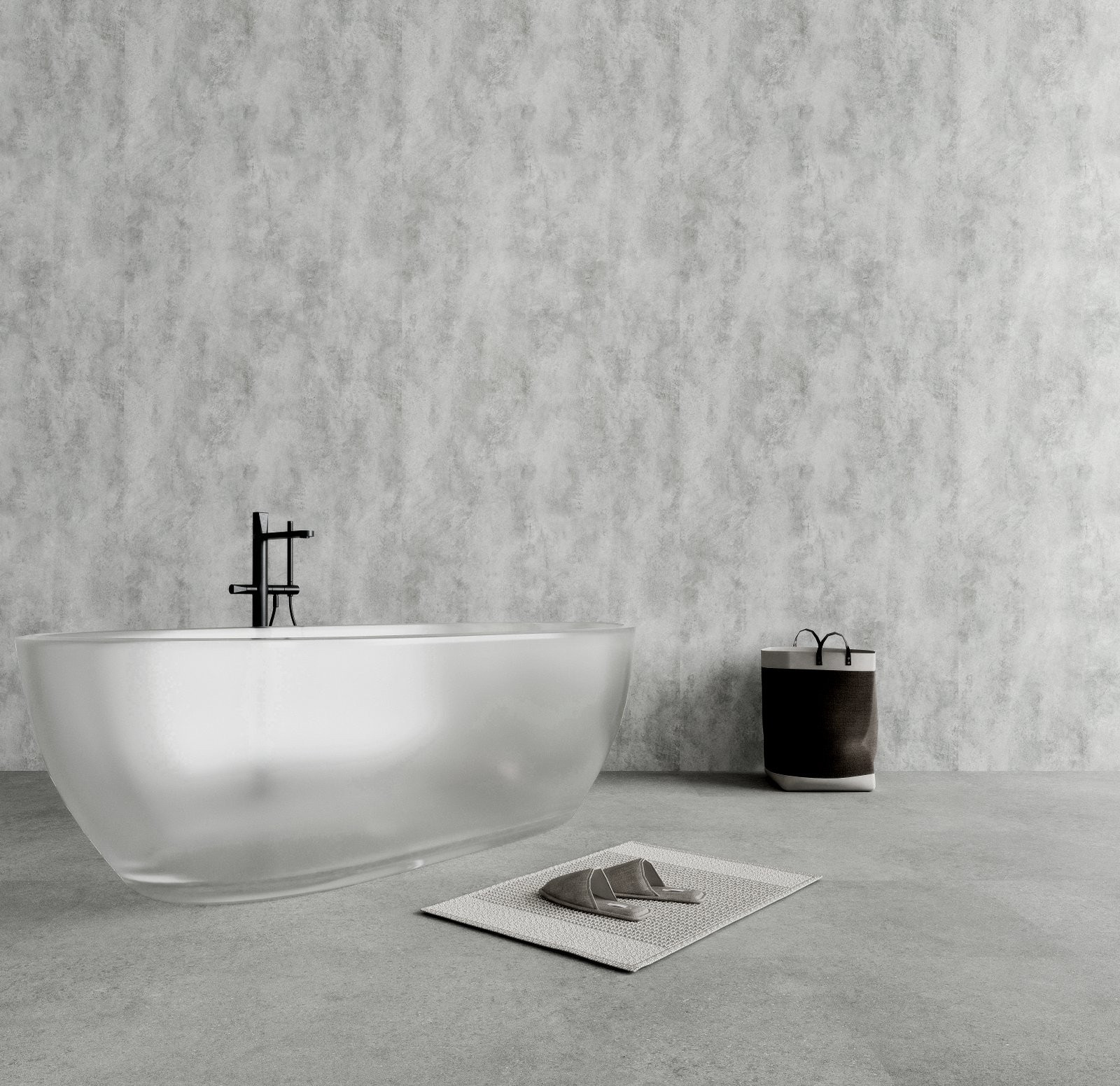
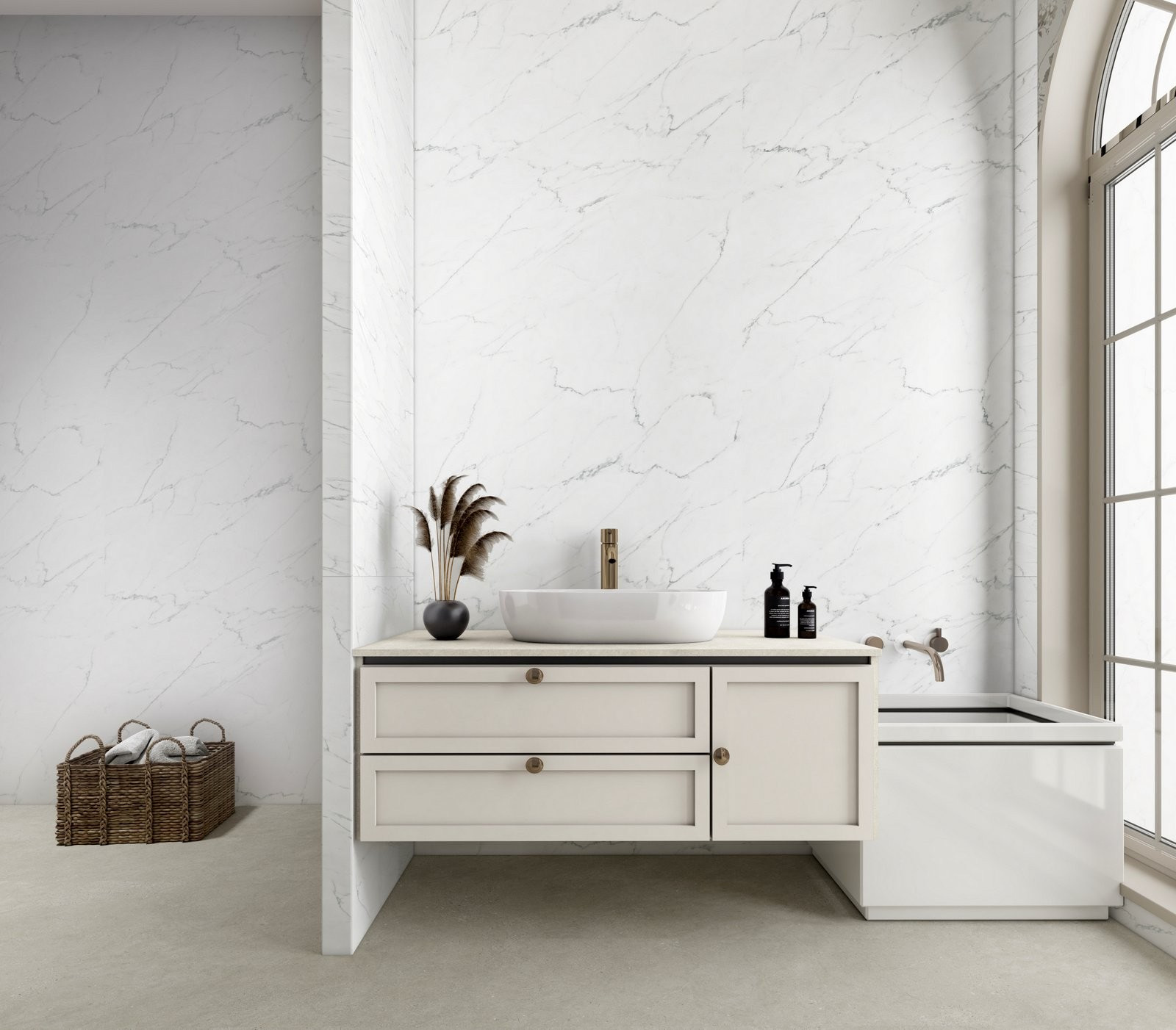
Light marbles such as Seria and Neria make a small bathroom feel larger and brighter; Solena, a black marble, turns one wall into a feature. The concrete and microcement decors of the Stone series — Venezia, Lunara and Casa — give a calm, even backdrop that suits black or brushed-metal fittings, and the vein-cut stone designs of the Roccia series add warmth without a busy pattern. If the floor is a MILAT design from the Roccia or Cava series, the same decor is also produced as a wall panel, so floor and wall can run in one material.
Cleaning and upkeep
The surface is closed and non-porous, made without phthalate plasticisers, and it resists bacterial growth. A damp cloth and a mild cleaner are enough; there is nothing to re-seal and no grout to bleach. Keep the perimeter detailing intact — if a joint at the bath or shower tray is damaged, repair it rather than leave it.
Sources & references
Talk to MILAT Floor
Samples, specifications, OEM & private label, wholesale or export — our team is ready.
MILAT Floor is an SPC flooring manufacturer with its own factory in Gaziantep, Türkiye — buy manufacturer-direct.