
Rigid core vinyl is the answer to an old vinyl complaint: floors that dented, telegraphed every subfloor bump, and felt cheap. Give vinyl a hard, dimensionally stable core and most of those problems disappear.
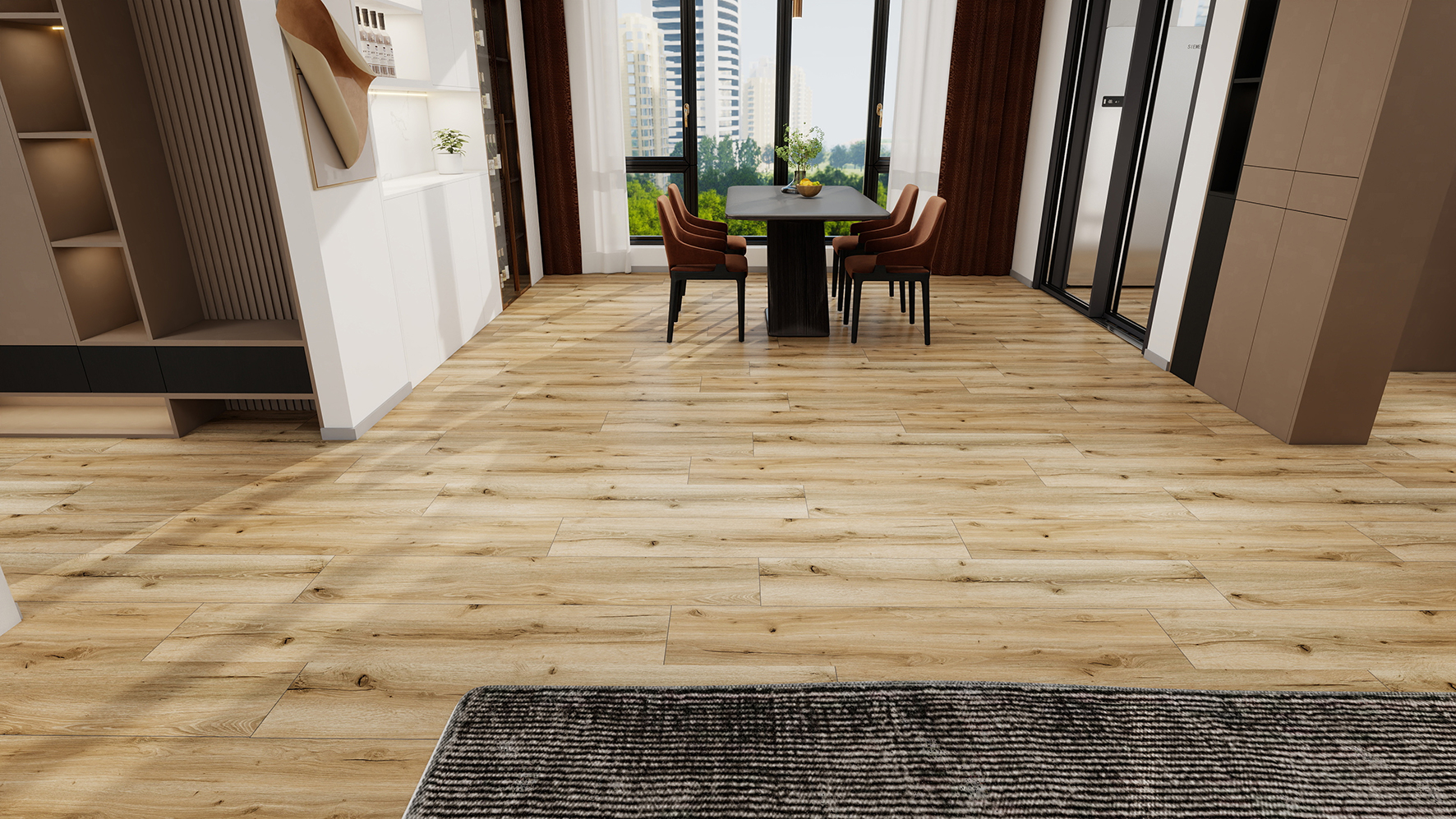
What rigid core means
Rigid core describes a vinyl floor built around a solid, inflexible plank rather than a bendy one. Try to snap a piece across your knee and you cannot. That stiffness is the whole point. It lets the plank bridge small dips in the subfloor, stay flat through temperature swings, and click together as a floating floor with no glue.
The two families of rigid core are SPC and WPC. Both sit under the broad 'rigid LVT' umbrella, and both share the same layered logic as flexible LVT — print film, wear layer, backing — with the flexible middle swapped for something solid.
SPC: stone plastic composite
SPC uses a core of limestone powder (calcium carbonate) blended with PVC and stabilisers, pressed into a dense, thin, hard board. It is the more rugged of the two: very stable in heat, highly dent-resistant, and slim enough to fit under doors and against existing floors without much transition. The trade-off is that it feels firmer and a touch louder underfoot, which a good acoustic backing offsets.
WPC: wood plastic composite
WPC replaces much of the stone content with a foaming agent, creating a core full of tiny air pockets. That makes the plank thicker, warmer, softer, and quieter than SPC, at the cost of some dimensional stability and dent resistance. In a bright, sun-facing conservatory, SPC's heat stability usually wins; in a cosy bedroom, WPC's cushioning appeals.
| SPC | WPC | |
|---|---|---|
| Core | Limestone and PVC | Wood-flour foam and PVC |
| Feel | Firm, thin | Softer, thicker |
| Heat stability | Excellent | Good |
| Dent resistance | Higher | Moderate |
| Best for | Sun rooms, commercial, wet areas | Bedrooms, comfort-first rooms |
What 'rigid LVT' really means
Marketing muddies this. 'Rigid LVT', 'rigid core', 'EVP' (engineered vinyl plank), and 'click vinyl' all point to the same idea: an LVT surface bonded to a hard core that floats and clicks. When you see those terms, the real question is which core sits underneath — SPC or WPC — because that decides feel, stability, and where the floor performs best.
MILAT's SPC flooring uses a 100% waterproof stone-composite core with a licensed Unilin click and an IXPE acoustic layer, the kind of build that defines the rigid category. The click system matters as much as the core; a licensed locking profile is what keeps seams tight through years of expansion and contraction.
Rigid versus flexible: which to choose
Choose rigid core when your subfloor is not perfectly level, when you want a floating floor you can install without adhesive, or when the room sees water and temperature changes. Choose flexible glue-down LVT when you have a flawless subfloor, want the thinnest and quietest possible floor, or need to work neatly around fixed obstacles where a glued sheet behaves better. For most renovations, rigid core is the more forgiving pick.
How a rigid core plank is actually built
A rigid plank starts as a hot extruded core: mineral powder and polymer blended, pressed into a dense board, and calibrated flat. Onto that go the layers that make it a floor — a printed decor film, a transparent wear layer, and a UV-cured lacquer on top, with an acoustic pad bonded underneath. Then the click profile is milled into the edges. Each stage sets a quality ceiling: a poorly mixed core snaps, a thin print looks flat, a rushed profile clicks badly. When you compare planks, you are really comparing how carefully five processes were run.
Why texture matters more on a rigid board
A rigid plank sits dead flat and takes light evenly, which is unforgiving to a bad print — flat gloss over a wood image reads as plastic from across the room. Embossed In Register texture solves this by pressing the surface grain so it aligns with the printed grain: a knot you can see is a knot you can feel. Combined with matte, low-sheen lacquers, EIR is the main reason modern rigid vinyl gets mistaken for timber. All 54 MILAT designs across the Exclusive, Perfecta and Triollo collections use EIR for exactly this reason.
The subfloor advantage nobody advertises
Flexible vinyl telegraphs everything: a grain of grit, a tile joint, an old screed scar all print through the surface in months. A rigid core bridges small imperfections instead, holding a flat plane over minor texture the way a board does and a membrane cannot. This is why rigid core is the renovation favourite — over old tile, over slightly scarred screeds, over surfaces that would need hours of skimming before sheet or glue-down vinyl could go near them. Flatness still matters, but the tolerance is honest rather than heroic.
A buying checklist for rigid core
- Wear layer rating matched to the traffic, up to AC5 for commercial use
- A licensed click system such as Unilin, not an unlicensed copy
- EIR surface texture and a matte finish for realism
- Attached acoustic pad, IXPE preferred, with a stated dB reduction
- Indoor air certification such as FloorScore
- CE Declaration of Performance if the floor is going into Europe
- A manufacturer who can supply the same decor again next year
Where the category came from, and where it is going
Rigid core emerged in the 2010s as an answer to two complaints at once: laminate hated water, and flexible vinyl hated bad subfloors. Fusing a waterproof mineral core with vinyl's printed realism solved both, and the category has been taking share from laminate and ceramic ever since. The direction of travel now is refinement rather than reinvention — quieter floors through better acoustic pads, tougher and lower-gloss coatings, deeper EIR textures, and tighter click tolerances. The core idea is settled; the craft is in the details.
Talk to MILAT Floor
Samples, specifications, OEM & private label, wholesale or export — our team is ready.